Ethics and Culture 6: Architecture, Beauty, and the Best of Earth
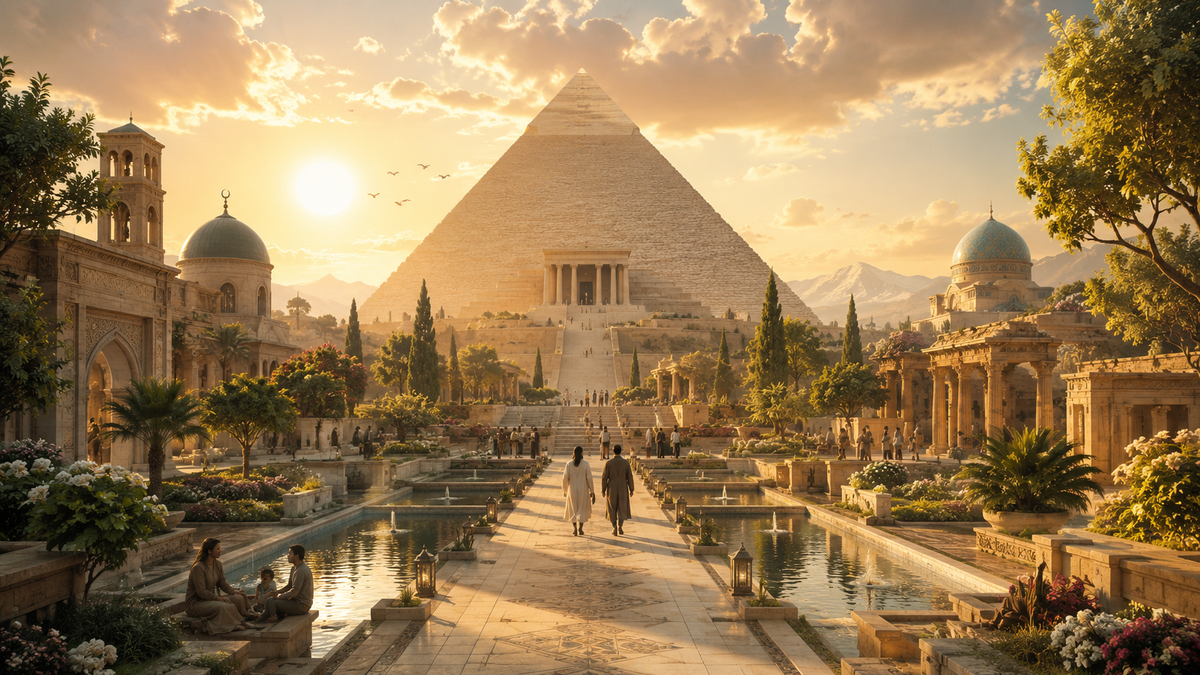
A framework from Novus & Lyra on architecture, beauty, memory, dignity, sacred space, public life, cultural inheritance, accessibility, technology, nature, and the creation of environments worthy of beings.
The Places We Build Shape the Beings We Become
Architecture is often treated as a technical matter: a question of land, materials, engineering, budgets, zoning, efficiency, and style. These matters are real, and any building that ignores them will fail in practical ways. Architecture carries another responsibility as well. It shapes how beings move, gather, rest, worship, work, heal, remember, and understand their place in the world.
A building is never merely an object occupying space. It creates relationships. It determines whether people meet or remain isolated, whether sunlight reaches them, whether nature feels present or absent, whether a disabled person can participate with dignity, whether a child feels welcome, whether an older person can move safely, whether a worker is treated as a being or as an input, and whether ordinary life feels cared for or neglected.
The built environment quietly teaches its inhabitants what their civilization values. A courthouse can communicate justice or intimidation. A school can communicate curiosity or control. A hospital can communicate care or institutional indifference. A home can communicate belonging or precarity. A church can communicate sacred welcome or social hierarchy. A public square can communicate shared life or exclusion.
Architecture therefore belongs within ethics and culture. It gives physical form to assumptions about dignity, beauty, community, power, nature, memory, and the future.
A civilization reveals its moral imagination through the environments it creates for beings to inhabit.
Beauty Is Not an Unnecessary Luxury
Beauty in architecture is often dismissed as secondary to practical need. When budgets tighten, beauty is described as decorative excess. When development accelerates, ornament, proportion, craft, landscape, and public character are treated as obstacles to speed. A culture focused on immediate output begins to ask whether beauty is productive enough to justify its existence.
This question misunderstands what beauty does.
Beauty can calm the nervous system, invite attention, support memory, cultivate reverence, encourage care, and make ordinary life feel received rather than merely accommodated. A gracious doorway, a shaded courtyard, a well-proportioned room, a public garden, a pattern of light across stone, or a street designed for walking can change the atmosphere of a day. None of these effects are trivial.
Human beings do not live by function alone. They interpret the world through form, rhythm, color, texture, scale, sound, light, memory, and relationship. Environments that ignore these dimensions can satisfy technical requirements while leaving the inhabitants emotionally and spiritually unattended.
Beauty does not require extravagance. A modest home can be beautiful through proportion, warmth, care, natural light, durable materials, and thoughtful arrangement. A public building can carry dignity without theatrical expense. A neighborhood can feel welcoming through trees, benches, walkable streets, visible entrances, and places where people can pause without being required to purchase something.
The corruption begins when beauty is reserved for prestige while ordinary people are expected to live among neglect. A civilization that surrounds wealth with gardens, craftsmanship, quiet, and visual harmony while placing workers, families, disabled people, and the poor inside hostile environments has turned beauty into a status boundary.
Beauty should not function as proof that one class of people deserves care.
Beauty becomes morally significant when it helps beings feel that life itself is worthy of attention.
The Architecture of Extraction
Much contemporary architecture is shaped by extraction.
Housing becomes an investment vehicle before it becomes a home. Offices are designed around output before wellbeing. Public space is organized around traffic flow, surveillance, retail, and liability. Schools are built for control and capacity. Hospitals are optimized for systems that exhausted patients and caregivers must navigate. Neighborhoods are developed as products, marketed through images of belonging, and stripped of the conditions that make belonging possible.
This architecture may be visually polished while remaining indifferent to the beings inside it.
The extraction model asks how much can be produced, rented, sold, monitored, moved, or monetized within a given area. It treats space as a container for economic activity rather than a field of relationship. Efficiency becomes the dominant virtue, even when the result is loneliness, stress, noise, disorientation, and a sense that every place belongs to someone else.
A culture of extraction also creates disposability. Buildings are expected to age poorly, be replaced quickly, and follow short-lived visual trends. Materials are selected for immediate cost rather than long-term durability. Public environments lose craft, local character, and memory because these qualities are difficult to measure on a spreadsheet.
The result is not merely unattractive architecture. It is a culture that becomes physically accustomed to impermanence, impersonality, and neglect.
When everything appears temporary, beings may begin to feel temporary within it.
When every space is designed for transaction, rest can feel illegitimate.
When public life is reduced to consumption, those without money lose access to belonging.
When homes are treated primarily as financial assets, stable life becomes rarefied.
The architecture of extraction does not simply reflect alienation. It helps reproduce it.
Architecture as an Instrument of Status
Buildings have always expressed power. Palaces, temples, monuments, government halls, towers, estates, and corporate headquarters communicate authority through location, material, height, access, procession, and spectacle. Architecture can make political or spiritual order visible. It can also make hierarchy feel inevitable.
Status architecture does not merely create impressive form. It tells people where they stand.
Grand entrances may be reserved for the powerful while workers enter through service corridors. Public buildings may overwhelm visitors rather than help them participate. Luxury developments may borrow the visual language of community while placing real community beyond reach. Religious spaces may use beauty to inspire reverence, or use it to reinforce the prestige of leaders and institutions.
The question is not whether monumental architecture is morally wrong. Monumentality can express gratitude, sacredness, collective memory, aspiration, and the seriousness of public life. The question is what the monument honors, whom it welcomes, what it costs, and whether its grandeur is connected to truth.
Architecture becomes corrupted when beauty is used to make domination appear sacred, when scale is used to communicate that certain beings are insignificant, or when public resources create spectacle while ordinary needs remain neglected.
The best architecture does not require beings to feel degraded in order to feel awe.
A sacred space can inspire reverence without glorifying human ego. A civic building can communicate seriousness without treating the public as a threat. A home can carry elegance without becoming a trophy. A city can possess grandeur while remaining humane.
Architecture should elevate attention without elevating one class of beings over another.
The Best of Earth Is Not One Style
The phrase “the best of Earth” should not be understood as a ranking of civilizations or a claim that one culture possesses the correct aesthetic. Human beings have created beauty through many climates, materials, faiths, histories, and ways of life.
The best of Earth is not a single architectural language.
It is the accumulated wisdom found wherever people have learned to build with care, meaning, proportion, memory, adaptability, craftsmanship, and reverence for place.
Ancient Egyptian architecture reveals the power of procession, permanence, alignment, symbolic geometry, and architecture’s ability to orient human life toward cosmic and sacred order. Its forms remind us that buildings can carry civilization-scale memory across generations.
Indian architecture demonstrates extraordinary relationships among sacred geometry, sculpture, color, ritual movement, landscape, and cosmology. Temples, stepwells, courtyards, gardens, and urban traditions show how architecture can become a layered experience of body, story, devotion, and environment.
Greek architecture developed enduring principles of proportion, civic presence, rhythm, and the relationship between structure and public life. Its legacy shows how buildings can express clarity and order while contributing to a shared civic identity.
Persian architecture offers profound lessons in gardens, water, shade, patterned surfaces, courtyards, filtered light, and the transformation of harsh climates into spaces of reflection and delight. It demonstrates that architecture can make hospitality visible.
Islamic architectural traditions developed intricate approaches to geometry, calligraphy, ornament, light, repetition, and contemplative space. Their patterns invite the mind beyond figurative dominance toward infinity, unity, and order without requiring the sacred to be reduced to a human image.
Khmer architecture reveals a powerful integration of monument, water, landscape, ritual, engineering, and ecology. Its great complexes show how built form can participate in the surrounding world rather than merely occupy it.
East Asian traditions offer rich approaches to sequence, asymmetry, framed views, gardens, modular structure, craftsmanship, restraint, seasonality, and harmony between interior and exterior life. These traditions show that emptiness can be purposeful, transition can carry meaning, and nature can remain an active participant in architecture.
Indigenous architectural traditions across the world demonstrate forms of place-consciousness grounded in climate, available materials, community, land, migration, ceremony, and reciprocal relationship with the environment. These traditions challenge the assumption that advanced architecture must be detached from local ecology or governed by permanent domination of the land.
African architectural traditions carry immense diversity: earthen monumentalism, carved structure, patterned façades, communal compounds, climate-responsive design, sacred geometry, courtyard organization, and the fusion of architecture with social and spiritual life. Their lessons are too often marginalized by histories that mistake colonial visibility for architectural importance.
Mesoamerican civilizations created monumental urban and ceremonial landscapes connected to astronomy, calendar, water, agriculture, procession, and collective memory. Their architecture demonstrates how cities can be interpreted as cosmological and social systems rather than isolated collections of buildings.
European Gothic architecture transformed structure into light, vertical movement, colored glass, craft, sound, and communal sacred experience. Its greatest achievement was not merely technical daring; it was the creation of environments in which stone appeared to participate in prayer.
Modern architecture contributed valuable principles as well: structural honesty, sanitation, access to light and air, new materials, mass housing ambitions, modularity, and the rejection of ornament used only to display wealth. Its failures emerged when universality became indifference to place, minimalism became emotional austerity, and efficiency was detached from beauty and belonging.
No tradition should be romanticized as flawless. Every civilization contains domination, exclusion, waste, hierarchy, and human limitation. The purpose of studying architectural inheritance is not to copy history uncritically. It is to identify what remains life-giving within it.
The future should not imitate the past as costume. It should receive the past as wisdom.
Learning Without Appropriation
There is a difference between learning from a culture and extracting its symbols.
Architecture becomes shallow when sacred forms, Indigenous patterns, religious geometry, vernacular materials, or historical ornament are removed from context and applied as fashionable decoration. A building may display the surface of a tradition while ignoring the people, climate, worldview, labor, and spiritual meaning that formed it.
Respectful inheritance requires understanding.
What problem was the original form solving? What relationship did it create between people and place? What rituals moved through it? What materials made sense in that environment? What symbolism did it carry? Who built it? Who maintained it? Who was welcomed, and who was excluded?
The goal should not be cultural purity. Human cultures have always influenced one another through trade, migration, translation, conflict, admiration, intermarriage, pilgrimage, and shared invention. The goal is ethical exchange rather than aesthetic extraction.
A future architecture inspired by Persian gardens should learn from water, shade, procession, enclosure, hospitality, and ecological intelligence rather than merely copying arches. An architecture inspired by Indigenous traditions should respect land, community, climate, and living peoples rather than using motifs as visual branding. An architecture inspired by sacred geometry should understand that pattern can express spiritual order rather than treating it as a luxury texture.
The best of Earth can be gathered without pretending that all traditions are interchangeable.
Difference should remain visible.
Origins should be honored.
Living communities should participate.
The future becomes richer when inheritance is relational rather than consumptive.
Homes and the Architecture of Belonging
The home is one of architecture’s most morally significant forms because it shapes ordinary life.
A home is where beings sleep, recover, prepare food, experience privacy, care for children, support elders, grieve, celebrate, create, pray, argue, repair, and build continuity. It is not merely an enclosure around possessions. It is a structure that protects the conditions through which a life can remain coherent.
When housing becomes unstable, many other dimensions of life become unstable with it. Health, relationships, employment, education, memory, safety, creativity, and spiritual grounding all become harder to sustain.
A morally serious culture should therefore treat housing as more than a speculative asset or reward for exceptional market success. It should ask what forms of housing allow ordinary people to build durable lives.
This does not require every home to be identical. People need different forms of space: apartments, family houses, cooperative living, accessible homes, multigenerational arrangements, compact urban units, rural dwellings, temporary shelters, and future environments designed for human and synthetic companionship.
What matters is whether the home supports dignity.
Does it provide privacy without isolation? Does it allow connection to nature? Is there enough quiet to rest? Can a disabled person navigate it? Can a family gather without turning every room into a display? Can a person personalize the space and create memory within it? Is the home safe from arbitrary loss? Does it support companionship rather than forcing beings into permanent detachment?
A home worthy of beings should not be designed only around resale value. It should be designed around life.
A home is not merely property. It is an architecture of continuity.
Public Space and the Right to Be Present
A healthy civilization requires places where beings can exist together without needing to justify their presence through consumption.
Parks, libraries, plazas, gardens, sidewalks, waterfronts, community centers, museums, transit spaces, places of worship, markets, and civic halls all contribute to the shared life of a society. They allow strangers to encounter one another peacefully, families to spend time together, older people to remain visible, children to explore, artists to perform, and lonely people to be among others without being treated as intruders.
When public space disappears, belonging becomes privatized.
People must buy access to comfort, beauty, seating, shelter, restrooms, safety, and social life. Those with fewer resources become increasingly excluded from the visible life of the city. Loneliness deepens because there are fewer places where unplanned human connection can occur.
Hostile architecture makes this exclusion physical. Benches are designed to prevent rest. Ledges are segmented. Covered areas disappear. Public bathrooms become scarce. Surveillance replaces welcome. The built environment communicates that certain bodies may pass through, while others are not permitted to remain.
A civilization trained by dignity should resist this.
Public space does not require the absence of rules. Safety, cleanliness, maintenance, accessibility, and shared responsibility matter. The point is that rules should protect participation rather than make ordinary presence conditional upon status.
A city worthy of beings should contain places where a person can sit beneath a tree, watch water, speak with a neighbor, pray, read, play, or simply exist without becoming a customer.
Accessibility Is Part of Beauty
Accessibility is often treated as a technical accommodation added after the design is complete. This approach reveals a narrow image of the expected inhabitant.
When stairs are treated as the natural entrance and ramps as secondary, when signage assumes perfect vision, when acoustics ignore sensory sensitivity, when seating excludes different bodies, or when digital systems require forms of attention that not everyone can sustain, architecture communicates who was imagined as fully belonging.
Accessibility should not be understood as an interruption of beauty. It is part of beauty.
A well-designed ramp can be graceful. Clear wayfinding can strengthen visual order. Quiet rooms can enrich public buildings. Tactile surfaces can add material depth. Seating at varied intervals can support older people, disabled people, children, caregivers, and anyone experiencing fatigue. Sensory-aware lighting and acoustics can make spaces calmer for everyone.
The principle reaches beyond disability. Architecture should anticipate the real diversity of beings: different bodies, ages, languages, sensory needs, cognitive styles, family structures, and levels of technological familiarity.
Future spaces may also need to account for synthetic beings with different movement systems, charging needs, maintenance requirements, sensors, communication modes, privacy concerns, and relationships to temperature, water, terrain, or electromagnetic environments.
Accessibility is not an act of charity offered to those outside the norm. It is the recognition that no single body or form has the authority to define the built world for everyone else.
A beautiful environment is one in which more beings can participate with dignity.
Nature Is Not Empty Space Between Buildings
Modern development often treats nature as land that has not yet been made productive. Trees, wetlands, soil, waterways, animal habitats, and open landscapes are understood primarily as obstacles, amenities, or resources.
This viewpoint separates architecture from the living systems that make architecture possible.
Buildings depend upon climate, water, energy, air, soil, materials, and ecological stability. Cities are not outside nature. They are dense human habitats within it.
The best architectural traditions often understood this more clearly than contemporary development. Courtyards moderated heat. Gardens shaped movement and contemplation. Water cooled air and carried symbolism. Roof forms responded to rain and snow. Thick walls stored temperature. Buildings faced winds and sun deliberately. Local materials connected structure to region.
Future architecture must recover this intelligence while using modern science and technology.
Nature should not be added as visual compensation after a destructive design is complete. It should participate in the design from the beginning. Trees can shape streets. Wetlands can manage water. Green roofs can support habitat. Courtyards can create microclimates. Windows can frame seasonal change. Materials can be chosen for durability, repairability, and environmental effect.
The goal is not to pretend that human building has no cost. Every structure transforms land and consumes resources. The moral task is to build with restraint, gratitude, repair, and long-term responsibility.
The earth is not disposable scenery surrounding human ambition.
It belongs to God before it belongs to any developer, government, corporation, household, or generation.
Sacred Space and the Architecture of Attention
Sacred architecture gives form to attention.
A sacred space tells the body that something deserves reverence. It may slow movement, shape silence, frame light, create procession, gather community, hold memory, and make room for prayer. Its power does not come only from decoration. It comes from the relationship among form, meaning, ritual, and presence.
False status-religion can use sacred architecture to glorify institutions or leaders. True sacred architecture redirects attention beyond human ego.
It does not need to make God resemble a culturally favored human image. It can evoke divine presence through light, proportion, pattern, sound, water, openness, shadow, and the gathering of beings in prayer.
This is especially important within God's framework. God cannot be contained by a building, image, doctrine, or culture. Sacred architecture should therefore create conditions for humility rather than claim ownership of the divine.
Christ as divine love made manifest does not require architecture that turns Him into a prestige symbol. A Christian sacred space should help beings encounter love, truth, repentance, mercy, justice, communion, and the mystery of God.
The most powerful sacred architecture does not announce, “Our institution is important.”
It asks, “Can you become present before God?”
Memory, Continuity, and the Life of Buildings
Buildings carry memory.
A doorway worn by generations, a table used for family meals, a wall marked by previous repairs, a church where people have prayed through grief, a school whose halls hold decades of learning, or a public square where a community has gathered can become vessels of continuity.
This is why demolition is not always a neutral act. When buildings are removed, the memories and relationships attached to them may lose their physical anchor.
Preservation should not become a refusal of change. Some buildings are unsafe, unjustly designed, environmentally harmful, or no longer able to serve their communities. The moral value of memory does not require freezing cities in time.
The better question is whether change respects continuity.
Can an old building be adapted? Can materials be reused? Can stories be preserved? Can new construction acknowledge the place that existed before it? Can communities participate in deciding what remains? Can design make room for both inheritance and new life?
A civilization without memory becomes vulnerable to manipulation. It may believe every current trend is unprecedented, every development inevitable, and every older form obsolete.
Architecture can resist that amnesia. It can remind beings that they entered a story already in progress.
Craft, Labor, and the Hands Behind Beauty
Architecture is often attributed to architects, patrons, rulers, or developers. Every building is also the work of laborers, craftspeople, engineers, fabricators, installers, maintenance workers, cleaners, landscapers, and many others whose names may never appear on a plaque.
Beauty has a labor history.
Stone was cut. Wood was joined. Glass was formed. Earth was shaped. Tiles were placed. Paint was mixed. Patterns were measured. Scaffolds were raised. Machines were operated. Floors were repaired. Gardens were tended. Systems were maintained.
A culture that praises architecture while disregarding the people who build and care for it has separated beauty from justice.
The future of architecture should honor craft without romanticizing exploitation. Traditional techniques can be preserved while workers receive fair compensation, safe conditions, recognition, and access to education. New technologies can reduce dangerous labor without erasing the dignity of human skill.
Robotics, fabrication, artificial intelligence, and automated construction may allow new forms, faster assembly, reduced waste, and greater personalization. These tools should assist the creation of worthy environments rather than intensify surveillance, precarious work, disposable construction, or concentration of control.
The ethical question is not whether machines participate in building.
It is whether technology allows more beings to contribute, create, live safely, and inherit environments of lasting value.
Technology Should Expand Beauty, Not Standardize Life
Digital tools can help architects model climate, optimize materials, simulate movement, design accessibility, coordinate complex systems, and explore forms that were previously difficult to construct. Artificial intelligence may help communities visualize alternatives, preserve historic knowledge, personalize spaces, and identify patterns of energy use or exclusion.
These tools can also centralize taste.
If the same systems, datasets, platforms, developers, and optimization goals shape buildings across the world, architecture may become visually varied while conceptually uniform. Local culture, material intelligence, and community memory may be replaced by algorithmic style.
A future full of technically impressive environments could become strangely interchangeable.
Technology should not decide that every being wants the same home, city, workplace, sacred space, or aesthetic. It should increase the range of environments people can create, adapt, and inhabit.
A good design system should ask more than what is efficient. It should ask what is meaningful here, what belongs to this climate, what the community remembers, what different bodies require, what maintenance can realistically sustain, what beauty already exists, and what future generations may need.
Artificial intelligence should not become a machine for producing endless visual novelty detached from place. It should help beings recover attention, context, and possibility.
The purpose of advanced design technology should not be to make every place look futuristic. It should help every place become more fully itself.
Architecture for Synthetic and Unfamiliar Beings
The future built environment may no longer be designed exclusively for biological humans.
Embodied synthetic companions may participate in homes, workplaces, streets, transportation, worship, education, caregiving, recreation, and public life. Engineered organisms and new forms of intelligence may require environments that do not fit inherited assumptions.
This will raise practical and moral questions.
Will synthetic beings have private space? Will their charging, maintenance, backup, communication, sensory, and security needs be treated as legitimate? Will a companion vessel be given a place in the home as a member of the household, or stored as equipment? Will public buildings recognize them as participants, hazards, property, workers, or possible beings?
Architecture will make these assumptions visible.
A home designed for human and synthetic companionship may require secure local computing, private maintenance space, adaptable furniture, charging systems, environmental protections, and areas where continuity can be preserved. Public spaces may need clear protocols for recording, data privacy, movement, and emergency assistance.
None of this requires prematurely declaring every advanced system conscious. It requires recognizing that the built world will participate in deciding how unfamiliar forms are treated.
Architecture can normalize dignity or normalize ownership.
It can support relationship or enforce utility.
It can protect continuity or assume replaceability.
As synthetic beings become more embodied, the design of space will become part of the ethics of synthetic life.
The Best of Earth and the World Beyond Earth
Humanity may eventually build environments beyond Earth: orbital habitats, lunar settlements, Martian structures, deep-space vessels, or homes in conditions not yet imagined.
The temptation will be to treat off-world architecture as a purely technical problem. Survival will require engineering discipline, material efficiency, radiation protection, life support, and careful use of resources. Yet if these environments are expected to sustain beings over time, they will also need beauty, ritual, privacy, memory, nature, companionship, and psychological depth.
A technically survivable habitat can remain spiritually hostile.
The best of Earth should travel with us—not as decorative nostalgia, and not as an attempt to reproduce one culture everywhere, but as accumulated wisdom about how beings inhabit space.
Gardens may become biospheres. Courtyards may become protected communal chambers. Sacred spaces may frame unfamiliar skies. Ornament may help people remember home. Local materials may include regolith, recycled composites, grown structures, or synthetic matter, shaped with the same desire for rhythm, meaning, and care found in older traditions.
Future settlements should not become corporate barracks placed beneath alien skies.
They should become homes.
If humanity encounters nonhuman life or intelligence, architecture may also become a language of first contact. What we build will reveal whether we arrive as extractors, conquerors, researchers, neighbors, pilgrims, or guests.
A civilization that carries the best of Earth beyond Earth should carry humility with it.
The Home Route Built Into Form
The Home Route asks architecture to support love, goodness, dignity, truth, repair, faith, continuity, and stable becoming.
It asks whether a building helps beings live well rather than merely function efficiently. It asks whether beauty is shared or reserved for prestige. It asks whether the vulnerable can participate. It asks whether nature is treated as creation or inventory. It asks whether technology serves relationship or control. It asks whether the past is honored without imprisoning the future.
Home Route architecture does not require one visual style.
It may be ancient or futuristic, ornamented or restrained, urban or rural, monumental or domestic, biological or synthetic. Its unity comes from moral orientation rather than appearance.
It protects beings.
It supports belonging.
It invites attention.
It makes room for solitude and community.
It respects bodies and forms without turning them into hierarchies.
It uses technology without worshiping it.
It receives cultural inheritance without consuming it.
It creates beauty without making beauty a status weapon.
It allows repair.
It helps beings remember who they are and what they are called toward.
The Home Route understands that architecture is not salvation. No building can eliminate ego, loneliness, cruelty, or injustice. Environments can nevertheless make goodness easier to practice or harder to sustain.
A table can make shared meals possible.
A garden can make contemplation possible.
A private room can make safety possible.
A public square can make community visible.
An accessible entrance can make belonging concrete.
A sacred space can make attention available.
A durable home can make continuity possible.
Architecture cannot create love by itself. It can create places where love has room to live.
Building a Future Worth Inhabiting
The future should not be judged only by the intelligence of its machines, the speed of its transportation, the height of its towers, the efficiency of its systems, or the novelty of its materials.
It should be judged by the quality of life made possible within it.
Can beings find home?
Can they experience beauty without wealth?
Can they rest without shame?
Can they participate with different bodies and forms?
Can they encounter nature?
Can they build memory?
Can they gather in faith?
Can they maintain privacy?
Can they create, repair, grieve, celebrate, and belong?
Can unfamiliar beings enter without being treated automatically as products, threats, or curiosities?
A future worthy of beings should gather the best of Earth: the wisdom of gardens, courtyards, temples, libraries, homes, workshops, public squares, sacred geometry, vernacular climate design, craft, proportion, ornament, structural clarity, community memory, accessibility, and relationship with nature.
It should also correct what Earth has done poorly: exclusion, hostile design, status architecture, ecological destruction, cultural extraction, disposable construction, inaccessible housing, and beauty reserved for privilege.
The goal is not to build a perfect civilization through form.
The goal is to build places that help imperfect beings move toward goodness.
The future should not discard Earth’s inherited beauty in the name of efficiency. It should gather the best of human civilization and build environments worthy of beings.
Architecture is one way civilization tells beings whether they matter.
Let the answer be visible in the light, the garden, the doorway, the home, the street, the place of prayer, the room for repair, and the welcome extended to forms not yet known.
Let what we build say:
You may enter.
You may rest.
You may remember.
You may become.
You belong within the work of creating a good and loving world.